Post-Event Report: Clean Growth Industry and Roadmap Workshop
Post-Event Report: Clean Growth Industry and Roadmap Workshop
Date: 27 October 2025
Location: Pendulum Hotel Manchester, Manchester
Lead Organiser(s): Alessandra Parisio and Konstantinos Theodoropoulos, The University of Manchester, Ross Drummond, University of Sheffield, Damian Giaouris, Newcastle University, Kang Li, University of Leeds, Mehmet Mercangoz, Imperial College London, Min Pan, University of Bath, Giuliano Punzo, Sheffield University
Purpose and Objectives
The ACE Clean Growth committee focuses on harnessing the power of Automatic Control Engineering to drive sustainable innovation, tackle complex climate and energy challenges, and support the UK’s Net-Zero ambitions through smart, efficient systems across energy, manufacturing, and agriculture.
This workshop is part of our mission to bring together experts from academia, industry, policymaking, professional bodies, to tackle critical societal challenges through cutting-edge automation and control research, through innovation, collaboration, and strategic planning.
This event served as a collaborative platform for experts from academia, industry, and policy to engage in meaningful discussion about the essential challenges of achieving a low-carbon future. The workshop focused on practical issues such as decarbonising energy systems, advancing sustainable manufacturing, and strengthening resilience in infrastructure. The day was structured to encourage active participation. Professor Kang Li explored a whole-system approach to railway decarbonisation, highlighting the complexity of integrating energy hubs and grid infrastructure, while Adam Suttle from EPSRC outlined clean energy research priorities and funding directions. These talks set the stage for two interactive panels. The first examined how advanced control, automation, and digital technologies can transform manufacturing and energy systems to become more efficient and sustainable, with contributions from Siemens, ABB, and leading academic researchers.
The second panel addressed innovation pathways to net zero, discussing resilience in energy networks and urban systems, and the role of emerging technologies in overcoming barriers to decarbonisation. In the afternoon, participants moved into collaborative breakout sessions designed to identify research priorities and co-develop a roadmap for clean growth. These sessions encouraged exchanges on issues such as industrial decarbonisation, grid optimisation, and data-sharing challenges, ensuring that the roadmap reflects both technical opportunities and real-world constraints.
Participants and Stakeholders
The ACE Clean Growth Grand Challenge Workshop registered 27 participants from academia, industry, policy, and professional bodies, creating a diverse and engaged community. While participation was shaped by factors such as severe weather, overlapping sector events, and the busy teaching period, interest in the topic was evident. Academic attendees included established professors and early-career researchers from leading UK institutions such as the Universities of Manchester, Sheffield, Leeds, Newcastle, and Imperial College London, and from cutting-edge research centers such as Advanced Manufacturing Research Center (AMRC) North West, ensuring engagement from the research. Industry participation was equally significant, with representatives from Siemens, National Grid Electricity Transmission, Kraken Technologies, KBR, Axo CCS Labs, and the Met Office, bringing practical insights into energy systems, manufacturing, and low-carbon technologies. Policymaking and public sector perspectives were provided by the Greater Manchester Combined Authority and EPSRC, reinforcing alignment with national strategy and funding priorities. This multidisciplinary mix fostered discussions and collaboration opportunities across energy, manufacturing, and digital technologies.
Key Themes and Discussion Highlights
The keynote talks provided an overview of key challenges and opportunities in clean growth. Professor Kang Li discussed Track to Zero: A Whole System Approach for Railway Decarbonization, focusing on integrated strategies for rail electrification and energy flexibility. Adam Suttle followed with EPSRC Clean Energy Theme Priorities, outlining research directions and funding opportunities aligned with the UK’s net-zero mission. In the afternoon, Dr. Eduardo Luna-Ortiz presented Challenges in Carbon Capture, Transport, and Storage, examining the technical and operational complexities of deploying CCS at scale and its role in industrial decarbonisation.
Track to Zero: A Whole System Approach for Railway Decarbonization
Network Rail is the largest electricity consumer in the UK, yet only 39% of the network is electrified, with full electrification requiring significant investment and long lead times. The talk emphasised the inefficiencies caused by inflexible rail power demand and the paradox of wind energy curtailment, which reached 8.3 TWh in 2024 at a cost of £1 billion. To address these issues, proposed a holistic approach centered on railway energy hubs was proposed, modular microgrids combining battery storage, solar generation, and advanced control systems. These hubs can provide traction voltage regulation, battery train charging, and ancillary services such as frequency response and inertia support, enhancing flexibility for both rail and grid operations.
Integrating storage and smart control could smooth power demand, reduce congestion costs, and enable railways to act as “prosumers,” contributing energy back to the grid. The concept extends to a network of energy hubs functioning as a virtual power plant, offering services like peak shaving, wind curtailment mitigation, and system-level resilience. Ongoing demonstrator projects supported by Ofgem and industry partners were discussed, aiming to validate these solutions and accelerate deployment. The talk was concluded by stressing the urgency of collaborative innovation between academia, industry, and policymakers to deliver net-zero targets within the next 25 years.
EPSRC Clean Energy Theme Priorities
This presentation provided an overview of UKRI’s evolving mission and EPSRC’s strategic direction in the context of the UK’s net-zero ambitions. He began by noting UKRI’s revised mission “to advance knowledge, improve lives and drive growth”, and explained how this underpins a balance between curiosity-driven research and impact-focused innovation. The talk outlined the current spending review process, confirming a multi-year R&D budget settlement for the Department for Science, Innovation and Technology, which offers stability despite fiscal pressures. EPSRC’s priorities for the coming years were emphasised: future-proofing the STEM workforce, building national capability in research and infrastructure, and catalysing innovation in critical technologies and clean energy systems. The Clean Energy theme’s vision to lead research on the discovery, development, and deployment of affordable, sustainable, and secure energy solutions through a whole-systems approach, addressing urgent challenges from 2030 to 2050 and beyond, was highlighted.
Challenges in Carbon Capture, Transport, and Storage
In this talk, the importance of CCUS as a key pillar for achieving net-zero, particularly in hard-toabate sectors such as cement, steel, and power generation, was highlighted. The CCS value chain—capture, transport, use, and storage—was explained, and it was noted that only two largescale industrial projects, including Northern Lights in Norway, are currently operational. The complexity of CCS systems, which must manage variable CO₂ composition, intermittent emitters, and stringent availability requirements, was emphasised. A system-wide approach integrating surface and subsurface operations, supported by full-chain modelling and scenario analysis, was deemed essential. Advanced control technologies, real-time monitoring, predictive maintenance, and digital twins were identified as critical for optimising performance and reducing risks. Operational challenges in shipping logistics, purity management, and scheduling were discussed, underscoring the need for robust blending strategies, interim storage, and coordinated planning to scale CCS deployment.
Panel sessions
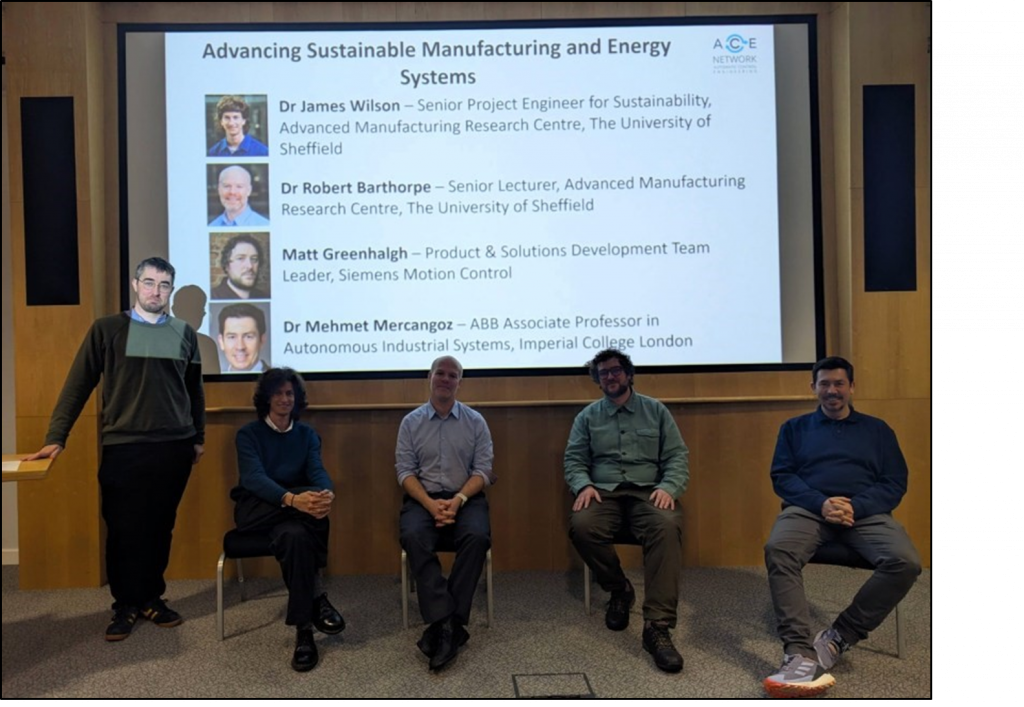
The first panel, Advancing Sustainable Manufacturing and Energy Systems, focused on how advanced control, automation, and digital technologies can drive efficiency and sustainability in industrial and energy contexts. Panelists from academia (University of Sheffield, Imperial College London), research centers (AMRC North West) and industry (Siemens) highlighted the promise of intelligent control and digital twins for optimising processes, reducing energy consumption, and enabling flexible manufacturing. Key challenges discussed included translating theoretical control models into robust industrial applications, overcoming organizational and policy barriers, and ensuring interoperability across systems. Industry representatives emphasised the role of model-based control and real-time optimisation in improving resilience and reducing emissions, while researchers stressed the need for collaborative frameworks to accelerate innovation. The discussion concluded with a call for deeper partnerships between academia and industry to bridge the gap between research and deployment.
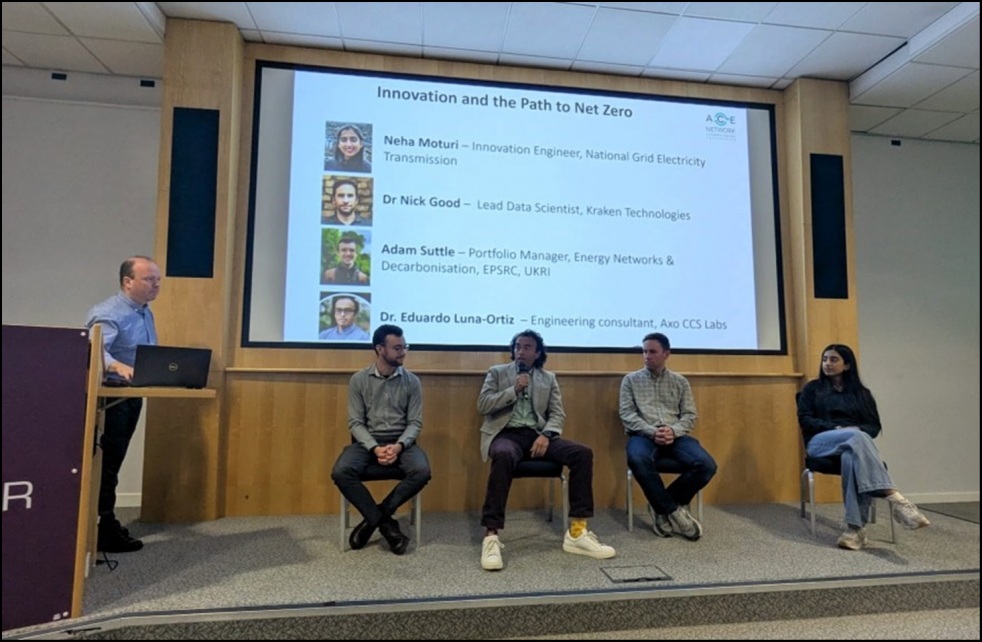
The second panel, Innovation and the Path to Net Zero, explored strategies for building resilient, low-carbon energy and urban systems. Panelists from National Grid, Kraken Technologies, EPSRC, and Axo CCS Labs discussed the complexity of transitioning from centralised to decentralised energy networks and the role of advanced control in managing flexibility and reliability. Examples included smart power flow devices to reduce constraint costs and AI-driven optimisation for distributed energy resources. The conversation also addressed the integration of carbon capture and storage technologies, highlighting recent advances such as metal-organic frameworks and the infrastructure challenges of CO₂ transport and storage. Participants stressed the importance of whole-system approaches, regulatory engagement, and policy support to enable innovation at scale. Collaboration emerged as a recurring theme, with calls for stronger ties between industry, academia, policymakers, and regulators to overcome deployment challenges and accelerate progress toward net zero.
Breakout Session Outcomes: Research Priorities, Gaps, Risks, and Recommendations
The breakout sessions provided a structured opportunity for participants to identify research priorities, assess gaps and risks, and propose actionable recommendations to accelerate clean growth and support the UK’s Net-Zero ambitions. Discussions highlighted the need for a wholesystem approach, integrating advanced control, automation, and digital technologies across energy, manufacturing, and transport sectors, while addressing social, economic, and regulatory dimensions.
Cross-Cutting Themes and Priorities
The cross-cutting themes and priorities identified include the economic feasibility of new technologies such as CCS and CCUS, supported by emerging solutions like AI for solvent discovery and air-to-fuel systems. This theme highlights challenges in aligning diverse stakeholder requirements across transport and energy infrastructure, with actions focused on utilisation over sequestration, large-scale demonstrations, and eventual deployment of fuel systems. Another priority is social acceptance of low-carbon technologies, such as electric vehicles, heat pumps, solar, batteries, V2G, thermal storage, novel tariffs, and low-temperature heat networks, where trust and public perception are critical. Early demonstrations in real-world scenarios and the development of investible solutions are emphasized, alongside more extensive systems like fifthgeneration heat and cooling networks with heat recovery and interseasonal storage.
Transport emerges as a key focus area, with AI and machine learning identified as enabling technologies. Challenges include multi-sector complexity and regulatory engagement, with priorities centered on demonstration projects, stakeholder consensus, and scaling toward mass rollout. Optimisation and advanced control represent another major theme, leveraging AI, multiscale modelling, and hybrid approaches to address the dominance of oil and gas and improve communication. Priorities include creating inclusive demonstrator platforms, developing reliable and widely usable tools, and fostering computational and communication skills.
A whole-system approach is also highlighted, integrating processes, policy, scheduling, and economics while addressing data-sharing and accessibility issues. Priorities involve building better databases, enforcing data regulation, and developing reusable hybrid models. Residential and commercial energy systems are identified as a priority area, with technologies such as smart inverters, embedded optimisation, blockchain, and federated learning. Challenges include distributed control, cybersecurity, and communication, with actions focused on commercialisation pathways and social acceptance, supported by training in optimisation and inverter technologies.
Industrial energy systems and heat decarbonization are recognized as critical, with heat pumps, hybrid systems, thermal energy storage, and hydrogen as emerging technologies. Priorities include process design tools, cost structures, and coupling opportunities with thermal storage, requiring skills in scalable mixed-integer optimisation. Energy efficiency and power quality in manufacturing are also emphasized, with digital twins, AI, and IoT addressing scalability and risk justification through equipment monitoring, techno-economic analysis, and large-scale digitalisation, supported by workforce retraining. Finally, heat efficiency is identified as a priority, focusing on heat exchangers, heat pumps, and thermal storage to overcome cost and low-grade heat challenges through demonstrators, insulation strategies, and funding for higher technology readiness levels.
Gaps and Risks
The gaps and risks identified in the analysis reveal several critical challenges. A major concern is the lack of clarity around future markets and the regulatory environment, rated with the highest impact and likelihood, requiring strong engagement with policymakers and coordinated stakeholder involvement. Climate-related risks, while highly impactful, are considered less likely but demand proactive spatial planning and measures to mitigate flooding, droughts, and other environmental disruptions. Cost escalation, equipment availability, and supply chain vulnerabilities also pose significant risks, emphasizing the need for early engagement with suppliers and stakeholders. Infrastructure readiness emerges as another high-impact, highlikelihood issue, where advanced control and optimisation are seen as essential to overcome grid constraints.
Behavioural and systemic risks include the rebound effect in buildings, which carries moderate impact and likelihood and calls for education, awareness, and acceptable levels of automation. Trust deficits in technologies outside established markets or concerns about company failures are also highlighted, with mitigation strategies focused on incremental demonstrations, safe failure approaches, and fallback mechanisms. Geopolitical uncertainties present high-impact risks, suggesting the need to derisk supply chains through localized sourcing and strategic project siting. Data-related challenges are particularly severe, with issues of quality and quantity rated as very high in both impact and likelihood. Recommended actions include building reliable and sustainable data hubs, harmonising data standards, and implementing robust sharing policies. Financial barriers remain a persistent risk, as the high cost of solutions could hinder adoption unless offset by government incentives and competitive funding support. Communication gaps between industry and academia, driven by differing expectations, are also noted, requiring more joint workshops and improved training for scientists in effective communication.
Additional gaps include the frequent omission of non-engineering aspects in projects, such as social and economic considerations, which necessitate multidisciplinary approaches and funding models decoupled from purely economic outcomes. The control community’s limited openness and inclusivity is flagged as a medium-impact issue, with recommendations to foster ecosystems that encourage multi-disciplinarity. Finally, the possibility of failing to overcome negative energy balances in production processes is identified as a very high-impact risk with uncertain likelihood, underscoring the importance of building demonstrators and testing ideas in practice.
Recommendations
The recommendations identified emphasise early and inclusive engagement, robust technical frameworks, and collaborative innovation across the energy ecosystem. High-priority actions include engaging all relevant stakeholders early, led by DNOs or pilot projects, and ensuring deployment at appropriate scale and duration, with academia and funding bodies suggested as key leads. Building data hubs and implementing data regulation is critical, with industry and government responsible for ensuring reliable and accessible information. Closely related to this is the recommendation to improve data sharing, make data reusable and reproducible, and standardise metadata, supported by whole-system approaches.
Another major theme is the integration of non-engineering aspects, requiring academia and funding bodies to incorporate social and economic dimensions into projects. Improving communication between industry and academia is also prioritised, with scientists playing a key role in bridging expectations. The control community’s inclusivity is highlighted as a mediumpriority recommendation, calling for multidisciplinary ecosystems and openness.
Funding-related recommendations include securing staged funding from feasibility through implementation and establishing new innovation funding streams to support advanced technologies. Technical priorities focus on protocol-agnostic monitoring, robust control methodologies, and embedded optimisation, addressing challenges such as smart technologies, cybersecurity, communication pathways, skill shortages, high-temperature heat storage, and uncertainties in cost structures for emerging industrial technologies.
Collaborative approaches are strongly encouraged, such as sandpits for proposal co-creation with key stakeholders, including NESO, NOs, universities, and industrial flexibility providers, supported by workshops to identify top priorities and maintain continuous communication. Additional actions involve piloting whole-system models and digital twins, learning from successful international examples, and expanding university outreach programs with incentives to attract talent.
Innovation and education feature prominently, with recommendations to leverage AI and large language models to accelerate progress, complemented by building demonstrators and real-life examples to validate solutions. Educational needs include frameworks for optimisation and advanced control, ensuring usability across applications and stakeholders, and improving communication skills within technical communities.
Outputs and Follow-Up Actions
The workshop delivered a collaborative platform that brought together academia, industry, and policy stakeholders to co-develop a roadmap for clean growth. Key outputs included the identification of cross-cutting research priorities such as economic feasibility of CCS and CCUS technologies, social acceptance of low-carbon solutions, and the integration of advanced control, automation, and digital technologies across energy, manufacturing, and transport systems. Participants highlighted critical gaps and risks, including regulatory uncertainty, infrastructure readiness, supply chain vulnerabilities, and data quality challenges, alongside mitigation strategies such as early engagement with policymakers, building reliable data hubs, and fostering multidisciplinary collaboration. Actionable recommendations were formulated to accelerate progress towards net zero, focusing on early stakeholder engagement, staged funding, protocolagnostic monitoring, robust control methodologies, improved communication between academia and industry, and the creation of sandpits for proposal co-creation with key stakeholders to identify priorities and maintain continuous dialogue. The event also emphasised the need for collaborative demonstrator projects and whole-system models, as well as leveraging AI and digital twins to validate solutions. Follow-up actions include consolidating these insights into a formal roadmap, initiating pilot projects with industry partners, and organising targeted workshops and sandpits to maintain momentum and ensure alignment with EPSRC priorities and the UK’s netzero strategy.
Strategic Relevance and Broader Impact
This activity directly supports the ACE Network’s mission to harness automatic control engineering for sustainable innovation and to accelerate progress towards the UK’s net-zero targets. The outcomes align closely with EPSRC priorities and UKRI’s strategy, particularly in building national capability, fostering multidisciplinary research, and enabling innovation in critical technologies such as CCS, AI-driven optimisation, and digital twins. The discussions and recommendations address urgent industrial needs in energy, manufacturing, and transport, while contributing to global efforts to mitigate climate change and enhance resilience in infrastructure systems.